
Scale & Size Guide: How to Choose the Right Scale for Your Model
Scale ratios, model dimensions and display space explained
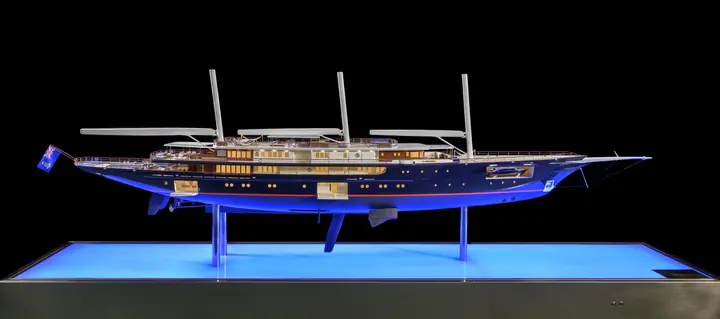
Choosing the scale is one of the first decisions in any scale model project. The scale defines the final size of the model, the level of detail that can be reproduced, the space needed to display it and how it will be transported.
This guide explains how scale ratios work, which scales are typically used in each sector and how to choose the right scale and size for your project.
What Does a Scale Ratio Mean?
A scale ratio compares the size of the model with the size of the real object. At 1:50, every 1 meter of the real project becomes 2 centimeters on the model. At 1:500, the same meter becomes 2 millimeters.
The model dimension is calculated by dividing the real dimension by the scale number:
- a 90-meter superyacht at 1:50 becomes a model of 1.8 meters;
- the same superyacht at 1:100 becomes a model of 0.9 meters;
- a 341-meter FPSO at 1:250 becomes a model of about 1.36 meters;
- a 1-kilometer waterfront site at 1:1000 becomes a model of 1 meter.
Larger scales (such as 1:20 or 1:50) produce bigger models with more visible detail. Smaller scales (such as 1:500 or 1:2000) make it possible to show very large areas in a compact physical model.
Typical Scales by Sector
There is no single correct scale, but most projects fall within these ranges:
- Mechanical cutaway models (1:1 to 1:10): pumps, turbines, engines and equipment where internal components must be clearly visible at trade show booths.
- Superyachts and villas (1:20 to 1:50): high detail for decks, furniture, interiors, railings and landscaping.
- Buildings, cruise ships and FPSOs (1:100 to 1:300): residential and commercial towers, passenger liners, offshore vessels and platforms.
- Industrial plants and offshore facilities (1:100 to 1:500): refineries, LNG plants, treatment facilities and process layouts.
- Master plans and cities (1:500 to 1:2000): waterfront developments, city districts, ports and islands, where the overall layout is the priority.
How to Choose the Right Scale
The right scale is the one that balances visual impact, level of detail, available space and practical handling. These are the questions we consider with every client:
1. How much display space is available?
Measure the space where the model will be displayed: a sales gallery, a trade show booth, a lobby or a museum room. Leave room around the model so visitors can walk around it and view it from every side.
2. How close will people look at the model?
Models viewed at arm's length, such as on a reception table or a booth counter, benefit from larger scales and fine detail. Models viewed from a distance, or from above, can use smaller scales.
3. What level of detail is needed?
If the presentation must show interiors, deck furniture, apartments or internal mechanical parts, a larger scale is needed. If the goal is to explain the relationship between buildings, roads and landscape, a smaller scale is more effective.
4. How will the model be transported?
Very large models are manufactured in separate sections that fit into custom aluminum flight cases and are assembled on site. Our largest urban development model measured 18 × 12 meters and was assembled at the client's venue.
5. How many models are needed?
When several copies are needed, for example for different sales offices or trade shows, a smaller scale can reduce cost and simplify transport. Multiple units and several scales of one design can be produced in the same order.
Model Size and Cost
Scale and size have a direct impact on cost. A larger model requires more material, more components and more assembly time, and needs a larger base, cover and flight case. A smaller scale with the same overall size may require less detail but more elements. Every TNBuilt West proposal includes the recommended scale and the final model dimensions.
Not Sure Which Scale to Choose?
You do not need to decide the scale before contacting us. A simple 2D PDF with the main dimensions of your project, together with the available display space and the intended use of the model, is enough for our team to recommend the most suitable scale.
Send your project information to TNBuilt West and we will recommend the scale and size that best suit your display space, budget and presentation goals.
Go to Next Guide:“How Much Does a Professional Scale Model Cost?”